
High Court gives 'break' to Tribune Chowk Flyover; Ban on cutting of trees, project work halted for now
Tribune Chowk Flyover: The Punjab and Haryana High Court on Friday stayed the felling of trees for the proposed Tribune Chowk flyover project, effectively bringing the process to a standstill. Initially, the Chief...
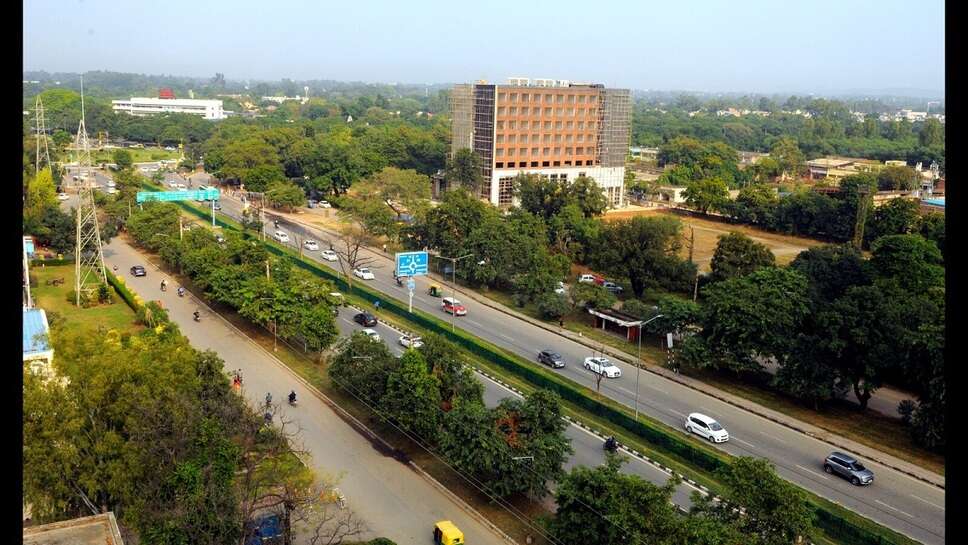
Tribune Chowk Flyover: The Punjab and Haryana High Court on Friday stayed the felling of trees for the proposed Tribune Chowk flyover project, effectively bringing the process to a standstill.
Initially, a division bench of Chief Justice Sheel Nagu and Justice Sanjiv Beri observed that the matter has already been heard and a final decision is likely to be taken at some point soon. The bench asserted that in such a situation, it would be appropriate to restrain the UT administration and other respondents from cutting or trimming any mango tree or any other tree in the vicinity of Tribune Chowk.
The court, at the same time, referred to the temporary nature of the order and said that “the interim directions, however, will remain subject to the final outcome of the petition.” The order came on a petition challenging the proposed flyover at Tribune Chowk, which had objected that the project violated the heritage character and planning framework of the city.
During the hearing, the petitioners’ counsel, Advocate Tanu Bedi, argued that the proposed flyover is against the Master Plan of Chandigarh and will adversely affect the urban design, green belts and pedestrian-friendly character of the city. Citing Master Plan 2031, the petitioner’s counsel had said that Chandigarh was planned as a pedestrian- and cyclist-friendly city and flyovers affect the city’s view and non-motorized traffic.
He further argued that expanding the infrastructure for private vehicles will only shift the crowd from one point to another and the proposed flyover The UT's senior standing counsel Amit Jhanji, on the other hand, opposed the petition and argued that the master plan allows construction of flyovers. He also said that only the area from Sector 1 to 30 has been recognised as a heritage zone, and not the entire city. Jhanji said that the project has already survived judicial review. He pointed out that the High Court had lifted the earlier ban on felling of trees after a "comprehensive review of the merits", and there is no challenge left in the Supreme Court against this order as the special leave petition was withdrawn in September 2024.
Defending the project on the grounds of necessity, he said that there has been a drastic change in the population dynamics of Chandigarh. "While the city was planned for five lakh people, now the population of the tri-city is over 15 lakh," he argued.
He added that the infrastructure was "of the 1950s." cannot remain frozen in the concepts of ". Terming the flyover as a "functional necessity", Jhanji pointed out the traffic jams that would take up to 1.5 hours for commuters coming from Zirakpur and Delhi. He added that the project falls under Phase-II (Sector 31 onwards), which, unlike the heritage-sensitive Phase-I, was designed for high density and modern infrastructure.
On environmental concerns, he said mitigation measures are already underway, including planting 2,799 saplings in a ratio of 5:1. He added that the protracted litigation since 2019 has "stalled the city's progress for a decade," leading to increased costs and inconvenience to the public, while assuring that all environmental clearances will be obtained before the project is implemented.