
Millions of Followers in Just a Few Days! What Is the 'Cockroach Janata Party,' and Who Is Its Founder, Abhijit Dipke?
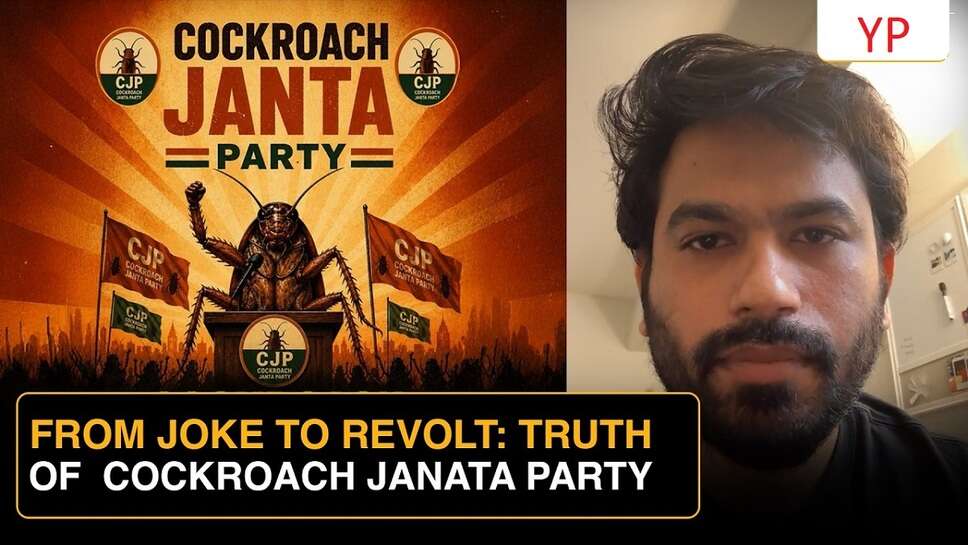
Following a statement made by Supreme Court Justice Surya Kant regarding the youth and cockroaches, a social media campaign titled 'Cockroach Janata Party' has garnered significant attention.
Justice Surya Kant's remarks have sparked widespread discussion surrounding a satirical social media campaign. At the center of this conversation is the 'Cockroach Janata Party' (CJP).
A website bearing the party's name has already been launched on the internet, and its Instagram account has amassed over 4 million followers. Furthermore, reports suggest that more than 200,000 people have registered on the website to become members.
What is the CJP, and how did it begin?
The Cockroach Janata Party's website identifies its founder and convener as Abhijit Dipke.
Yuvapatrkaar.com team spoke at length with Abhijit Dipke, who explained the reasons behind his decision to launch this social media campaign.
When asked where the idea for such a campaign originated, Abhijit Dipke replied, "I was browsing through Twitter (now X) and came across a statement by the CJI (Chief Justice of India), in which he compared the country's youth to cockroaches and parasites for daring to criticize the system and express their opinions."
"I found this utterly absurd, as the CJI is regarded as the guardian of the nation's Constitution—the very document that guarantees every individual the freedom of expression. How, then, could a person entrusted with upholding the freedom of expression compare the youth to cockroaches and parasites?"
"This filled me with anger and frustration, prompting me to voice my opinion on Twitter. I posed the question: 'What would happen if all the cockroaches came together?' I received an overwhelming response from Gen Z and young people under the age of 25, who suggested that we should indeed unite and create a collective platform." "This gave me the idea that we should create an online parody party, to be named the 'Cockroach Janata Party.' If you insist on calling us cockroaches, then fine—we will form the Cockroach Janata Party. I established specific eligibility criteria for joining this party: for instance, you must be 'lazy,' as the CJI alleged; you must be 'unemployed'; and you must be someone who is 'constantly online,' just as the CJI had described."
"Every single word the CJI used to disparage the youth—we adopted those very terms as the eligibility criteria for becoming a member of this party. Within just a few hours, it worked wonders; people began reacting to it en masse and started registering themselves as members."
"Subsequently, we realized that this was growing into something massive—it was no longer just a joke—because people were genuinely frustrated. Consequently, we launched a dedicated website and drafted a party manifesto. We have now garnered two million followers on Instagram (a figure that has since surpassed four million), and over 200,000 people have officially registered themselves as members of the Cockroach Janata Party. In the context of Indian politics, this represents an unprecedented phenomenon—something not witnessed in a very long time."
What accounts for such remarkable success?
Several prominent public figures have also publicly endorsed Abhijit Dipke's initiative.
Commenting on this, Abhijit states: "Former cricketer and Member of Parliament Kirti Azad expressed his desire to join the party. TMC MP Mahua Moitra also extended her support to the cause. Beyond these individuals, numerous others have rallied behind us, and today, this movement has become a major topic of public discourse. Moreover, its momentum continues to grow stronger with each passing day."
When we discuss this subject with people in the digital marketing field, they describe it as a disruptive force within the digital media landscape.
What is the story behind amassing a following of over 4 million people on social media?
Responding to this question, Abhijeet says, "I wouldn't claim that I achieved all of this single-handedly. It is the people themselves who have come together. We must understand what it is that has united them. If a digital agency or a political party were to attempt something like this today, they wouldn't achieve such rapid success—no matter how much money they spent. Even after spending crores of rupees, one wouldn't witness a response of this magnitude."
"The frustration and anger that have been simmering among the youth for years are the root cause of this massive response. The youth are unemployed due to the government's failures. They found a platform where they could vent their frustration and anger."
Who is Abhijeet Deepke?
A leader is indispensable to any political party or movement. Who, exactly, is Abhijeet Deepke?
Addressing this question, he states, "I hail from Chhatrapati Sambhaji Nagar in Maharashtra. I moved to Pune for my undergraduate studies. Subsequently, I had the opportunity to work with the Aam Aadmi Party for a few years, serving as a member of their communications team."
"I was drawn to them because of their focus on healthcare and education. It was something novel—something happening for the very first time in Indian politics. Much like the 'Cockroach Janata Party' feels fresh and new today, I felt at the time that they were poised to bring about a transformative change. I worked with them for a while, but eventually, I felt the need to pursue further studies; so, I returned home to prepare for my Master's degree. I subsequently received an acceptance offer from Boston University. I have been here for two years and have since completed my graduate studies."
The manifesto of the Cockroach Janata Party is quite attention-grabbing. Responding to this, Abhijeet says, "I feel that, at this moment, the manifesto speaks to the state of India's democracy and its current political landscape. We are constantly witnessing judges—who are supposed to remain impartial and have no ties to the government—accepting favors from the government after their retirement. This is extremely dangerous because the judiciary is meant to remain independent. If the judiciary, too, begins to toe the government's line, what will be left? Who, then, will save our democracy?"
"The second point concerns women's representation. Since childhood, I have heard promises that women would be granted 33 percent reservation; yet, to this day, this has not materialized. If you intend to provide reservation for women, then grant them a full 50 percent."
What is India's Gen Z like?
Gen Z-led movements have been observed in both Nepal and Sri Lanka. In Nepal, in fact, the movement was so impactful that it forced the government to resign. What are Abhijeet's thoughts when comparing the Gen Z populations of Sri Lanka and Nepal with that of India?
Responding to this question, he asserts that comparing India's Gen Z with their counterparts in Sri Lanka, Nepal, or Bangladesh would be "a grave insult," primarily because they (India's Gen Z) are not inciting violence.
Abhijeet explains, "India's Gen Z is expressing its discontent through the medium of satire. By donning cockroach costumes, they are symbolically cleaning up the Yamuna River and clearing away garbage. Through these actions, they are mocking the system. They are not taking to the streets to incite violence; and even if they were to take to the streets in the future, they would do so in a democratic and peaceful manner. This Gen Z demographic is, in fact, far more educated than our Union Cabinet. The question we ought to be asking ourselves is: why are we being governed by uneducated individuals?"
What does the future hold for the 'Cockroach Janata Party'? Will it remain merely a satirical social media campaign? To this, Abhijeet replies that this is just the beginning; in the days to come, even more youth organizations will step forward. He says, "The youth has grown fed up with the current political system. In the coming years, you will see the youth demanding change, for in the last 10–12 years, they have heard nothing but 'Hindu-Muslim' rhetoric."
"The youth wants to transform this political system—one where we are technologically advanced and where employment opportunities are available. Moving forward, we should benchmark ourselves against the world's best nations. How long can we continue to compare ourselves only with Nepal, Pakistan, and Bangladesh? Indian Gen Z desires this, and they refuse to be treated like cockroaches."
Will Abhijeet return to India after his time in the US? Responding to this question, he affirms that he will certainly return.
He stated, "I completed my graduation just last week, and I will return to India to take this initiative forward, as people are rallying together. They seek change for the better. Within just four days of our inception, our registered membership has already exceeded 200,000. This signals that Gen Z wants a political front of its own."
Translation – Ravi Kumar